Feats, genes and links not matching a sequence are dropped
By default, gggenomes arranges the plotting area around the specified sequence set. It matches all provided feats, genes and links against the sequences and drops everything that doesn’t match. This makes it easy to manipulate what is shown on the plot by selecting/rearranging sequences of interest.
Because feats, genes or links not matching sequences could also be the result of a data mismatch rather then a intentional selection (e.g. misformatted IDs), gggenomes issues a notification about this behavior every once in a while.
Let’s try this out with some data. We use set of six viral genomes with sequences, genes and links. First, we plot all seqs and genes, then we change the sequence set while still providing the full gene set.
Loading required package: ggplot2
gggenomes v1.2.0

If you use 'gggenomes' in published research, please cite:

Hackl T, Ankenbrand M, van Adrichem B, Wilkins D, Haslinger K (2024).
"gggenomes: effective and versatile visualizations for comparative
genomics." _arXiv_. doi:10.48550/arXiv.2411.13556
<https://doi.org/10.48550/arXiv.2411.13556>.
Attaching package: 'gggenomes'
The following object is masked from 'package:graphics':

    layout
ℹ Items outside plot detected
Some of your feats, genes or links are not plotted because they fall outside
your given sequence set. This is expected if you zoomed in or picked a subset
of sequences. But it could also indicate a data mismatch. So we show this note
once in a while. Examples of dropped items are:
1 BVI_008A 568 822 emales + CDS BVI_008A_0001
2 BVI_008A 1040 2668 emales - CDS BVI_008A_0002
3 BVI_008A 2768 3028 emales - CDS BVI_008A_0003
This message is displayed once every 8 hours.
# or pick/reorder with gggenomes::pick()
p3 <- p1 |> pick(2, 6, 4, 5)

# plot next to each other
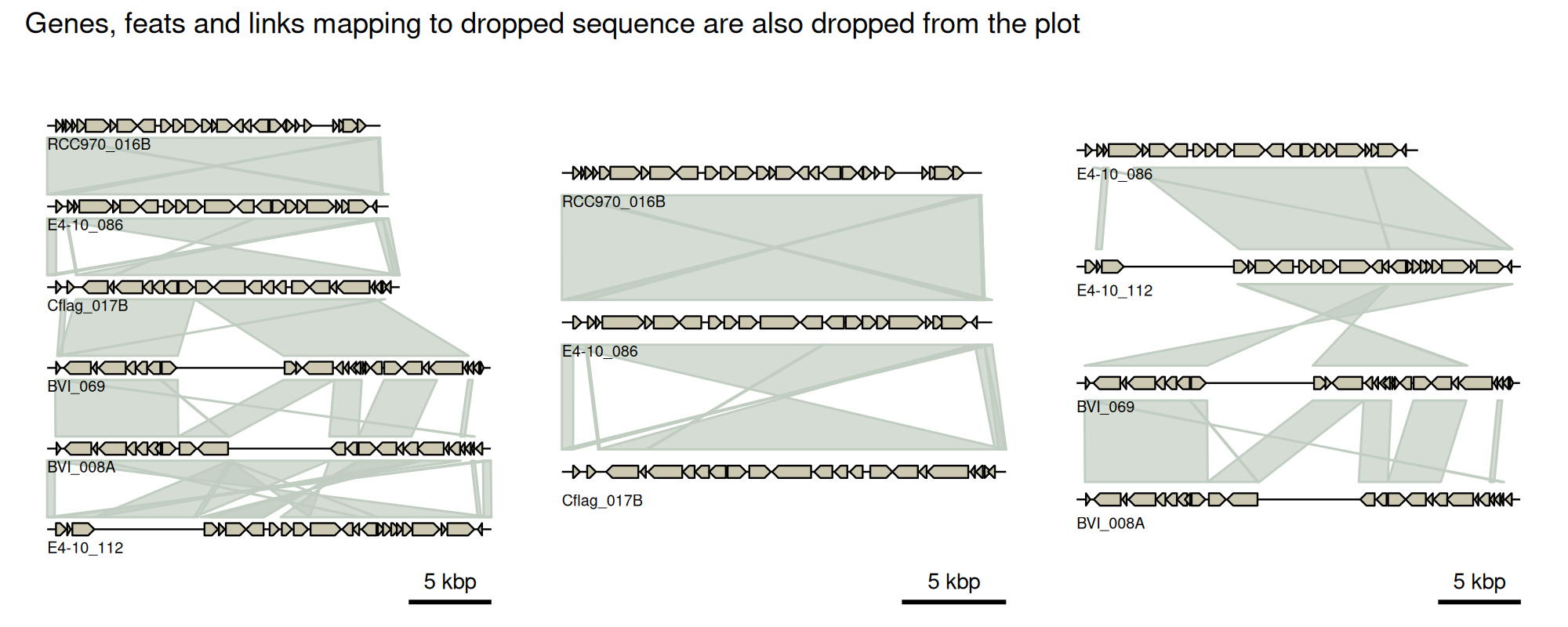
p1 + p2 + p3 + plot_annotation(title="Genes, feats and links mapping to dropped sequence are also dropped from the plot")
When using gggenomes with a sequence set that does not cover all provided genes, links etc., you receive a notification about items not matching the sequence set. When plotting, we can also directly see that only genes and links matching the specified sequence set are shown.
When zooming in, edge case handling can be customized
With gggenomes, we cannot only subset sequences, but also zoom in on specific regions or loci. This is done either by explicitly providing start and end coordinates for sequences or by using functions like focus(). As a result, only the parts of the orginial sequences within the specified loci will be plotted.
Genes, feats or links falling outside these new loci are dropped, similar to items not matching any sequence. However, there is a special case here: items that sit right at the edge of sequence loci and extend into the plot margins.
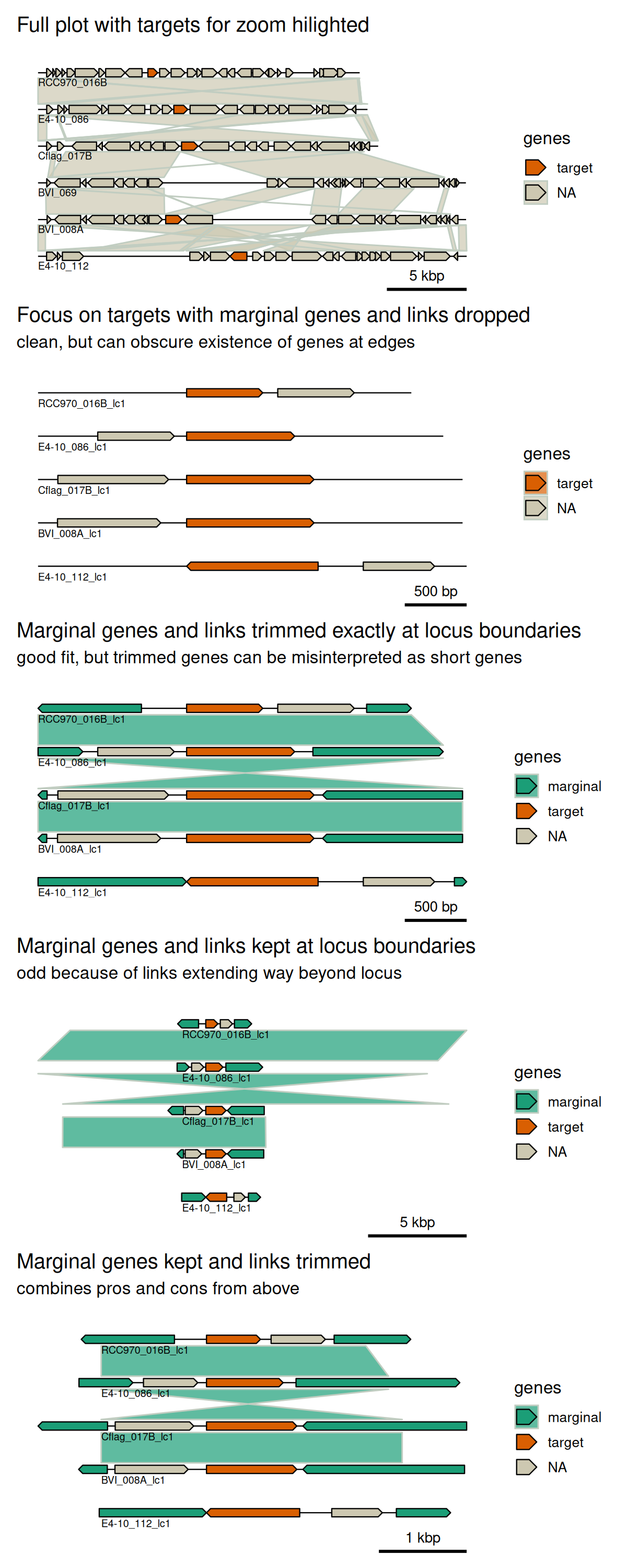
How these marginal items are handled, can be configured. By default marginal feats, genes and links are “drop”ped, but can be set to “keep” or “trim” instead. The latter will cut off the parts of the items that fall outside the loci, while keeping the rest.
Dropping as default was chosen because keeping marginal items sometimes leads to odd plotting behavior, e.g. when links are very long and cross the entire plot area, and then no changes are made to the link coordinates when zooming in. Trimming genes, i.e. showing something like half a gene is also easily misinterpreted (unless intentionally plotted as such). For links, trimming also not always makes sense, because even iftwo larger regions are “related” - as indicated by a link - that does not necessarily apply to different subregions of those larger regions.
Internally, marginal items are flagged in the their track tables with a logical column .marginal=TRUE/FALSE. To ensure users are aware of the existence of these edge cases and how they are handled, gggenomes issues a notification every once in a while if marginal features are encountered in the data.
Let’s look at some examples to showcase the different behaviors and options.
# This message usually only trigger once in a time. Let's reset its counter here
# to ensure it triggers for this tutorial
rlang::reset_message_verbosity("gggenomes-layout-marginal")

# plot some genomes and hilight genes ending with "10" in their ID
p4 <- gggenomes(seqs = emale_seqs, genes = emale_genes, links = emale_ava) +
  geom_seq() +
  geom_link(aes(fill=dplyr::if_else(.marginal, "marginal", NA))) +
  geom_gene(aes(fill=dplyr::case_when(
    stringr::str_detect(feat_id, "10$") ~ "target",
    .marginal ~ "marginal",
    .default = NA
  ))) +
  geom_seq_label() +
  scale_fill_manual("genes", values=c("target" = "#d95f02",
    marginal = "#1b9e77"), na.value="cornsilk3") +
    labs(title = "Full plot with targets for zoom hilighted")

# zoom in on the neighborhood of all genes ending with "10"
p5 <- p4 |>
  focus(stringr::str_detect(feat_id, "10$"), .expand = 1200) +
  labs(title = "Focus on targets with marginal genes and links dropped",
    subtitle = "clean, but can obscure existence of genes at edges")
ℹ Focusing on 5 loci, 3015-3462 bp wide, with .marginal='drop/drop'
ℹ Marginal items detected
Some of your feats, genes or links extend across the edges of your specified sequence loci and into the margins. By default, these marginal items are dropped. Adjust with:
• `gggenomes(marginal = c('drop', 'keep', 'trim'))`
• `focus(.marginal = c('drop', 'keep', 'trim'))``.
See `vignette('marginal', package = 'gggenomes')` for details.
p6 <- p4 |>
  focus(stringr::str_detect(feat_id, "10$"), .expand = 1200,
  .marginal = "trim") +
  labs(title = "Marginal genes and links trimmed exactly at locus boundaries",
    subtitle = "good fit, but trimmed genes can be misinterpreted as short genes")
ℹ Focusing on 5 loci, 3015-3462 bp wide, with .marginal='trim/trim'
p7 <- p4 |>
  focus(stringr::str_detect(feat_id, "10$"), .expand = 1200,
  .marginal = "keep") +
  labs(title = "Marginal genes and links kept at locus boundaries",
    subtitle = "odd because of links extending way beyond locus")
ℹ Focusing on 5 loci, 3015-3462 bp wide, with .marginal='keep/keep'
p8 <- p4 |> focus(stringr::str_detect(feat_id, "10$"), .expand = 1200,
  .marginal = c("keep", "trim")) +
  labs(title = "Marginal genes kept and links trimmed",
    subtitle = "combines pros and cons from above")
ℹ Focusing on 5 loci, 3015-3462 bp wide, with .marginal='keep/trim'
None of the options are always perfect, but depending on what you want to showcase, customizing the handling of marginal items should allow you to find a good solution.